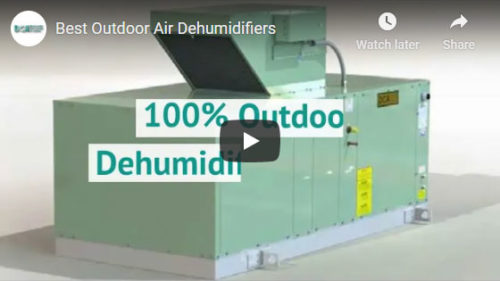
Outdoor air dehumidification systems have gained prevalence as more commercial buildings are properly sealed for energy efficiency and as local and national building codes change to capitalize on these energy savings. Ventilation and odor removal are among the reasons to push existing air out of space, and this requires 100% outdoor air intake to make up for this exhaustion of indoor air. Referred to as make-up air, this fresh air intake is inevitable and its dehumidification is essential for maintaining ideal indoor air quality, especially in moist humid climates. It is important to remove the excess moisture from outdoor air before it enters the building so the indoor HVAC system does not have to deal with this added moisture load.
Finding a 100% outdoor air dehumidification system is often not difficult, but finding one with the correct size and specs for your application may be the challenge. DCA builds a full line of 100% outdoor air units ranging from small 1.5-ton units up to 30.0 tons with 200 to 7000 CFMs. Our smaller 200 to 1200 CFM units may be the perfect solution for that office renovation project that you may be bidding.
Enthalpy Control
As the most common metric used in 100% outdoor air dehumidifiers, enthalpy control measures the total energy in the intake air. The right level of enthalpy depends on the level required by the space. An outdoor air dehumidifier that relies on enthalpy control is designed to remove moisture from the air while running at a lower flow rate than that of standard dehumidifiers. The outdoor air dehumidifier can also supply air at a broad range of temperature options, including neutral temperatures with the addition of the appropriate dehumidifier options.
Practical Benefits of Outdoor Dehumidifiers
Outdoor dehumidifiers provide several benefits in practical applications. To supply high-occupancy spaces like schools or office buildings with fresh air, 100% outdoor air dehumidifiers can pretreat outdoor air before it reaches the building’s air handling unit (AHU). This means the main AHU can be smaller, as it won’t need to manage additional loading of outdoor air. The AHU is the right size for managing the building’s own internal load, while the dehumidifier manages outdoor air.
Indoor pool rooms and other high-humidity indoor environments also benefit from 100% outdoor air dehumidifier solutions, which help manage make-up air from outside. When used with an internal re-circulating dehumidifier that removes moisture from the evaporating pool water, the 100% outdoor air dehumidifier can be adjusted as the seasons change, saving energy costs and consumption.
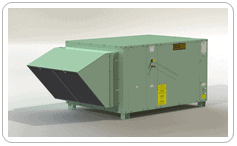
Indoor locations that benefit from air dehumidifiers for outdoor environments include:
- Large office spaces
- Educational institutions
- Lobbies and corridors of hotel and motels with indoor pools and spas rooms
An advantage of outdoor dehumidifiers is that the systems do not considerably affect the temperature of the air supply or create increased heating or cooling load. The air dehumidification solution works alongside the facility’s HVAC or make-up air system to remove undesired humidity. This is illustrated in more detail in this case study.
Fixed Reheating vs. Variable Reheating
Dehumidifiers (with an optional remote condenser) and air conditioning reduce the air temperature before it is supplied to a facility. During cooler months, an auxiliary fixed reheating system can improve comfort in the facility by heating and controlling some moisture in the air, but it can also incur higher energy costs due to its limited control over temperature.
On the other hand, dehumidification systems that rely on variable reheating can remove moisture while raising the temperature of the air being supplied. A variable reheat air dehumidifier can provide considerable savings compared to a fixed reheat system because it is better able to control heating and humidity.
Equipped with a remote condenser, air dehumidifiers for outdoor environments can remove moisture from the air and supply air with a neutral temperature. When combined with a DOAS, one can see many benefits.
DCA Dehumidifiers Engineered & Assembled in the USA
Craftsmen and women engineer and assemble DCA 100% outdoor air dehumidifiers in Cedarburg, Wisconsin. Not only are we experts in the field, but we also understand the local and national requirements with which your project must comply. For more information on our line of outdoor air dehumidification systems, contact our knowledgeable application team today.
Outdoor Dehumidification Systems for Demanding Environments
An outdoor dehumidifer is engineered to remove excess moisture from outdoor air streams before that air enters a building, process, or storage area. Unlike portable consumer units designed for basements or closets, industrial outdoor dehumidifiers are built to function reliably in extreme temperatures, wide humidity swings, and continuous-duty cycles. Whether installed at a manufacturing plant, pharmaceutical facility, water treatment site, or commercial cold-storage warehouse, an outdoor air dehumidification system provides stable, controlled humidity at the point of air intake — protecting equipment, products, and structural integrity from moisture-related damage. Humidity control at the perimeter significantly reduces the burden placed on interior HVAC systems and helps maintain consistent process conditions year-round.
How Outdoor Air Dehumidification Technology Works
The core of any dehumidification system is the process of extracting water vapor from an air stream and delivering drier, conditioned air downstream. Most outdoor air dehumidifiers use a refrigerant-based cooling cycle: warm, humid air passes across a cold evaporator coil, moisture condenses on the coil surface, and the now-dehumidified air is reheated to a usable temperature before being discharged. This cycle repeats continuously, maintaining a target dew point or relative humidity setpoint regardless of ambient outdoor conditions.
Understanding Deidcated Outdoor Air Systems for Commercial and Industrial Environments
A deidcated outdoor air System, commonly referred to as a DOAS, is an HVAC solution designed to handle all outdoor ventilation air independently from the building's primary heating and cooling system. Unlike traditional air handling units that mix return air with fresh outdoor air, a dedicated outdoor air system processes 100 percent outdoor air and delivers it directly to occupied spaces. This approach ensures that ventilation air quality remains consistent regardless of indoor return air conditions, which is particularly important in commercial buildings, healthcare facilities, and industrial environments where outdoor air quality and humidity levels can vary significantly throughout the year.
The primary function of a deidcated outdoor air System is to provide controlled ventilation while managing the latent and sensible loads associated with incoming outdoor air. By separating the ventilation function from the comfort cooling and heating functions, a dedicated outdoor air System allows each subsystem to operate at its optimal capacity. The outdoor air unit typically incorporates energy recovery technologies such as heat wheels, run-around coils, or plate heat exchangers to precondition the incoming air using exhaust air from the building. This energy recovery process significantly reduces the total energy consumption of the HVAC system while maintaining the ventilation requirements specified by ASHRAE standards and local building codes.
Humidity control represents one of the most critical performance criteria for any dedicated outdoor air System. In humid climates, the moisture load introduced by outdoor air can account for more than half of the total cooling capacity required by a building. A properly sized deidcated outdoor air System removes this excess moisture before the air enters the conditioned space, preventing issues such as mold growth, condensation on surfaces, and occupant discomfort. Dehumidification capability is especially important for facilities that house sensitive equipment, documents, or products that must be maintained within specific humidity ranges. Industrial moisture control applications may require additional dehumidification stages beyond what standard dedicated outdoor air Systems provide, including reheat coils or desiccant dehumidification modules for extremely high moisture load scenarios.
Installation of a dedicated outdoor air System requires careful consideration of the building layout, occupancy patterns, and the existing HVAC infrastructure. The outdoor air intake must be positioned to minimize the ingestion of contaminants such as vehicle exhaust, dust, or industrial emissions. Filters installed at the intake point typically range from MERV 8 to MERV 13, depending on the local air quality and the specific requirements of the building occupancy. In areas with poor outdoor air quality, such as near busy roadsides or industrial zones, higher filtration efficiency may be necessary to protect indoor air quality. The deidcated outdoor air System must also be integrated with the building's automation system to coordinate with the existing heating, cooling, and ventilation equipment for optimal energy performance and occupant comfort.
One of the key advantages of installing a dedicated outdoor air System is the ability to meet and exceed ventilation requirements established by ASHRAE Standard 62.1 and the International Mechanical Code. These standards specify minimum outdoor air delivery rates based on occupancy type and floor area, and a dedicated outdoor air System ensures that these rates are met at all times regardless of the status of other HVAC components. In many commercial applications, existing systems fail to deliver the required ventilation rates consistently, leading to poor indoor air quality and potential non-compliance issues. A dedicated outdoor air System eliminates this risk by providing a dedicated pathway for ventilation air that operates independently of the building's comfort conditioning system.
The technology available in modern dedicated outdoor air Systems continues to evolve, with manufacturers incorporating advanced control algorithms, variable air volume technology, and improved energy recovery devices. High-efficiency scroll or screw compressors are commonly used in integrated dedicated outdoor air and dehumidification units that combine air handling, dehumidification, and in many cases, heat recovery within a single packaged assembly. Some systems incorporate economizer operation, allowing the outdoor air unit to provide free cooling during cooler months by switching between mechanical cooling and direct outdoor air cooling when outdoor conditions permit. These technological advancements improve the energy efficiency and operational flexibility of dedicated outdoor air Systems, making them an increasingly attractive solution for new construction and retrofit applications alike.
Operating and maintenance costs for a dedicated outdoor air System are generally lower than those for traditional HVAC systems that do not separate ventilation from comfort conditioning. Because the outdoor air unit operates with a relatively constant load profile, components such as compressors and fans can be sized and selected for optimal part-load performance rather than worst-case conditions. Regular maintenance requirements include filter replacement, coil cleaning, belt inspection, and calibration of sensors and control equipment. Dehumidification performance should be verified periodically by measuring the leaving air humidity ratio and comparing it to design specifications. Most manufacturers recommend a preventive maintenance contract with an authorized service provider to ensure the system continues to perform as designed throughout its service life.
Proper design of a dedicated outdoor air system begins with an accurate calculation of the outdoor air ventilation rate based on occupancy density and space type, followed by an assessment of the moisture load in various climate conditions. Engineers use wet bulb and dry bulb temperatures from the local climate data to determine the enthalpy of incoming outdoor air throughout the year. The outdoor air unit must be capable of dehumidifying this air to a suitable supply air condition while maintaining the required airflow rate. Sizing the system too small results in inadequate dehumidification and potential indoor air quality issues, while oversizing leads to unnecessary capital costs and cycling that can degrade dehumidification performance through short cycle times.
Beyond the basic ventilation function, dedicated outdoor air Systems can be configured with additional features to address specific building requirements. Ultra-violet germicidal irradiation can be installed in the air handling unit to reduce microbial contamination in the air stream. Heat recovery wheels transfer both sensible heat and moisture between exhaust and supply air streams, further improving energy efficiency. Dedicated outdoor air Systems can also be designed with zoning capabilities to deliver different ventilation rates to different areas of a large building based on occupancy patterns and space utilization. Some applications, such as laboratory buildings or healthcare facilities, may require dedicated outdoor air systems with variable air volume control to accommodate fluctuating ventilation requirements throughout the operating day.
The choice between a packaged dedicated outdoor air System and a custom-assembled unit depends on factors such as the size of the installation, the availability of roof or mechanical room space, and the degree of customization required. Packaged units are factory-built, tested, and shipped as complete assemblies, which reduces on-site installation time and provides consistent quality assurance. Custom-assembled units offer greater flexibility for non-standard configurations and may be preferred for very large installations or applications with unusual spatial constraints. Both approaches can incorporate the same core technologies, including energy recovery, variable air volume control, and advanced filtration, and both require the same careful attention to proper ductwork design and terminal device selection for adequate airflow distribution.
DCA Dehumidifier Corporation of America designs and manufactures dedicated outdoor air systems engineered specifically for industrial, commercial, and institutional applications where precise humidity control and reliable ventilation performance are essential. With engineering staff available to evaluate your moisture load and match the right dehumidification system to achieve your desired results, DCA can help you implement a dedicated outdoor air System that meets your building's unique requirements. Properly sized and installed, a deidcated outdoor air System provides year-round ventilation and humidity control that improves indoor air quality, protects building assets, and reduces energy consumption compared to conventional HVAC solutions that mix outdoor ventilation air with return air.